

Key Takeaways
- Today’s risks are not new, but climate change, economic pressures and technology are amplifying their impact.
- Claims professionals are seeing a surge in AI-generated images and other manipulated evidence.
- AI is changing how work gets done, but human workers still provide value.
- AI can improve efficiency, but inaccurate outputs remain a concern in high-stakes coverage decisions.
- To stay competitive, P&C insurers need smarter tools, faster decision-making and real-time data flow.
Meet Bryan Falchuk
Bryan has worked in the property and casualty insurance sector for more than 25 years. Over the course of his career, he’s worked in different regions, different lines of the insurance business, and in different roles. Today, he’s known as the president and CEO of PLRB, a trade industry organization that supports property and casualty carriers operating in the U.S. He’s also a leadership coach, author, speaker and founding partner of Insurance Evolution Partners, an advisory firm that helps insurers innovate and evolve.
“I really like solving problems and going after opportunities, and it’s an industry where that just abounds. There are so many things we can do better and so many opportunities to seize.”
- Bryan Falchuk, PLRB
How Does PLRB Help Insurers Navigate Complexity?
Insurance professionals who are familiar with PLRB often associate it with the large conference that takes place every year. However, the conference is just one aspect of what PLRB offers. The organization maintains a massive database of case law, building codes and weather analytics, along with experts who analyze the data and field questions for members.
How Is AI Affecting P&C Claims?
AI is reshaping insurance claims on multiple fronts.
The rise of AI-generated evidence highlights a new challenge for insurers: distinguishing legitimate claims from increasingly sophisticated fraud. Claims professionals are seeing fraudulent images and manipulated or generated evidence, and Bryan warns it will only get worse and harder to spot as AI improves. PLRB offers education to help adjusters prepare, and those classes are usually full.
At the same time, claims professionals are worried about being replaced by AI. Bryan says he heard similar concerns when drones started doing the work of field adjusters. Looking back, we can see that drones did not replace adjusters, but the technology did make work safer and more efficient.
“I think there’s an existential threat for PLRB as there is for adjusters wondering will they have a job or will the next version of them have a job when AI could be doing this or that. I heard the same thing when drones came out,” Bryan explains. “There were a lot of adjusters who were worried about losing their job to the drones… Now you’re just not risking your life by going up the ladder and walking on that icy roof. You can send a drone up, get better images, and not risk slipping and falling.”
Will AI Change PLRB?
Bryan views AI as a powerful tool, but he believes insurance organizations must balance automation with expert oversight.
AI is effective at fielding questions, and hallucinations can be minimized, but models trained on broad, general information may struggle with highly specialized insurance questions. Half of the information on the internet is wrong, so models that are fed on that data might not provide the right answers. When it comes to coverage determinations, incorrect information can lead to incorrect payouts.
So how can PLRB seize the opportunity of AI while mitigating the risks? PLRB is testing internal AI tools first. These tools will help PLRB’s attorneys answer questions – a sort of human-in-the-loop approach. Eventually, PLRB may roll out member-facing AI tools, but Bryan thinks humans will always have a place in the organization.
“We have a path forward for our human staff, where I think they will always be needed because laws and coverage change, forms change and situations change, as do the exposures and the perils… So you need to have people who are looking at this, debating the coverage implications of it and creating the content to give guidance around that,” Bryan explains.
How Has Risk Evolved?
Risks are amplifying, which is not new, but a confluence of factors have pushed that amplification further. Climate change is creating instability. Storms aren’t just bigger and more frequent. They’re behaving differently. We’ve seen this with wildfire risks, the floods from Hurricane Harvey and an increase in hail damage, and Bryan warns it’s going to get worse. At the same time, there are also man-made and economic factors impacting claims faster than rates can keep up.
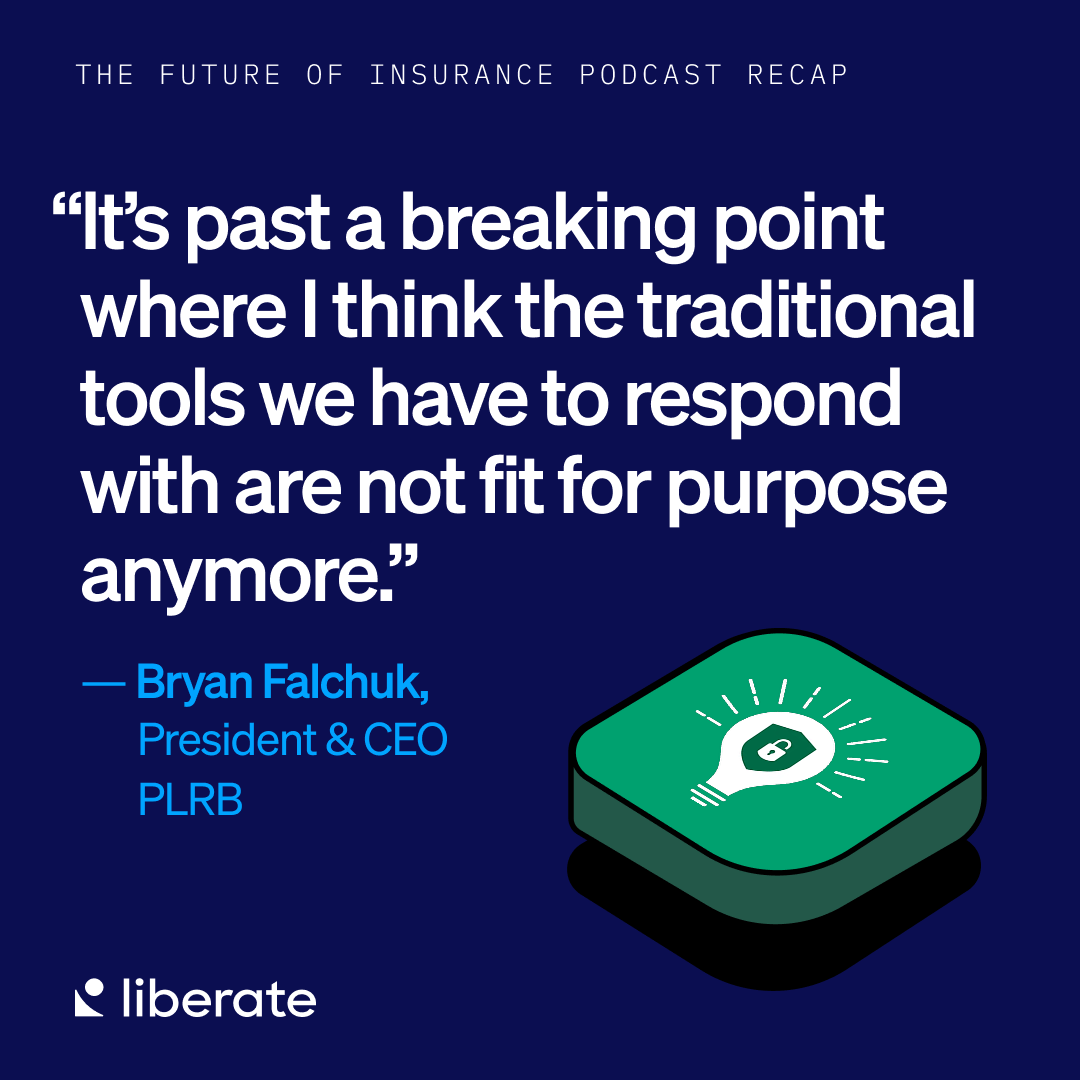
These changes are challenging traditional underwriting and pricing models, making it harder for insurers to respond using the tools and timelines they have relied on for decades.
How Can Insurers Stay Competitive?
Insurers have raised rates and pulled out of markets, but Bryan argues this isn’t the solution. More and more of the country will become uninsurable, so insurers need to find ways to provide coverage while staying profitable.
Bryan believes insurers need smarter tools, better access to real-time data and the ability to make decisions faster than traditional processes allow. The old way of doing things – annual rate reviews with changes that aren’t implemented until around two years later – doesn’t work anymore. Insurers need to be able to adapt. They also need strategies to close claims quickly at a fair amount – before attorneys and other parties have a chance to complicate matters.
“If you can close a claim faster, with less friction and agitation, you will get a better result,” Bryan explains.
From AI adoption and claims innovation to evolving risk exposures and market pressures, the property and casualty industry is entering a period of significant change. As risk grows more complex and technology continues to evolve, insurers will need new approaches to remain competitive.
To learn how industry leaders can prepare for what's next, watch the full interview.