Key Takeaways
- CAT events are not the best AI business case. Catastrophe-related call surges are temporary, making them a weak standalone justification for investing in Voice AI.
- The greatest ROI comes from everyday operations. Voice AI creates value every day by handling routine FNOL, policy service, billing, claims status inquiries, and other high-volume interactions.
- Better service can reduce claim costs and improve retention. Immediate guidance during routine losses helps policyholders take faster action, potentially limiting claim severity while improving the customer experience.
- CAT readiness is built through daily use. The same Voice AI platform that supports normal operations naturally scales during catastrophe events because it has already been proven in production.
- Measure success with operational metrics. Leading insurers start with call center KPIs, deploy one use case at a time, measure results, and expand based on demonstrated performance.
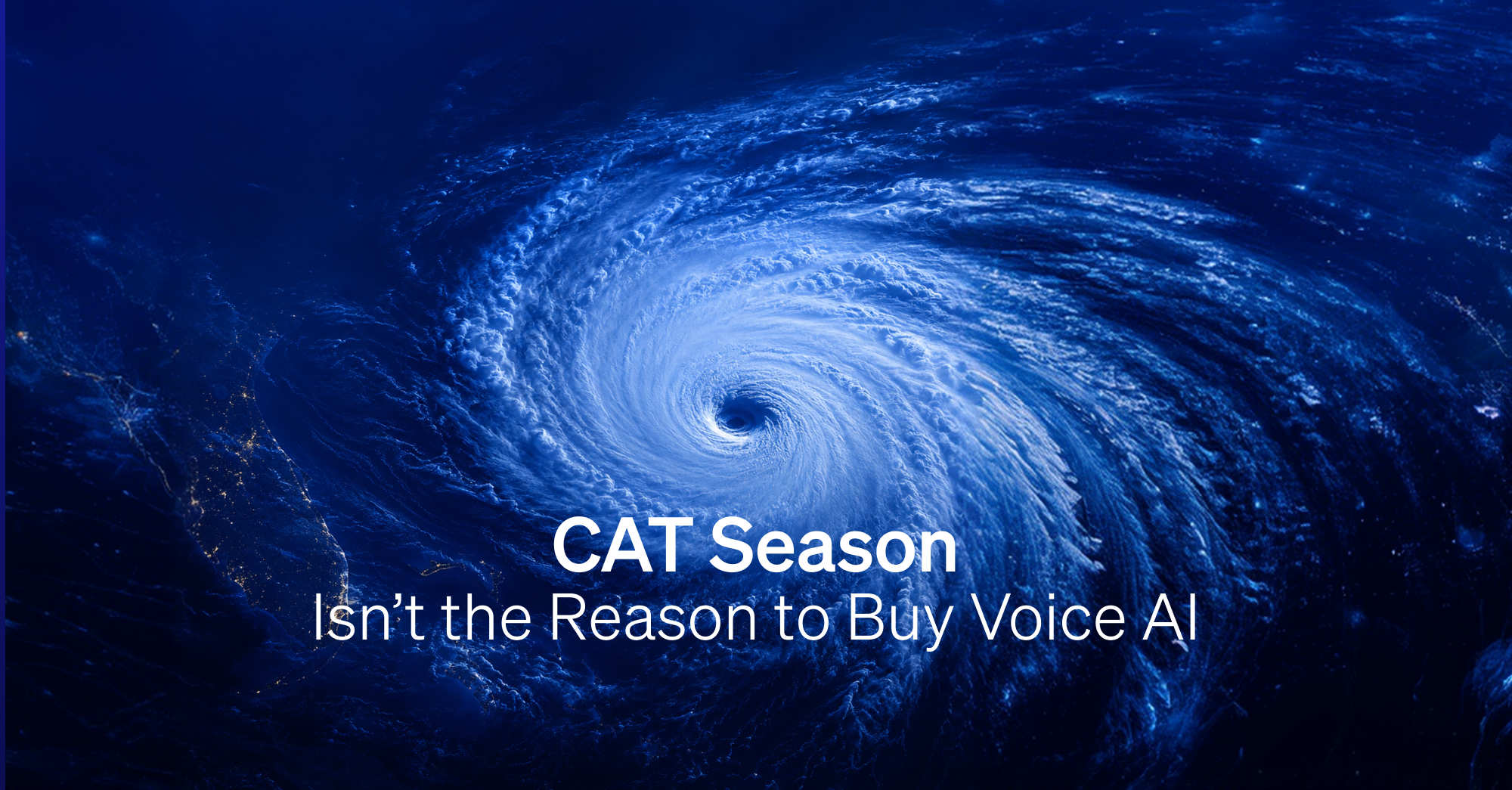
Every spring, I speak with Chief Claims Officers wondering if there’s still time to deploy Voice AI FNOL before hurricane season. I get it. CAT events are brutal. Volume spikes 4x, 5x, 10x in 48 hours. In some cases, policyholders who just lost their roof or home can wait on hold for hours. Policyholders feel the pain. Your team regrets the pain. The media reports the pain. It's all hands on deck and you have to do something.
But building your AI strategy around any specific moment is building around the exception, not the rule. It's the weakest business case for the technology.
The problem with building for the exception
A major hurricane season runs around four months. The actual surge, the days where call volume spikes dramatically, is measured in weeks. Sometimes days. CAT surge activates, at most, 3% of your operating calendar.
If you're buying AI for that window, you're building and deploying a complex platform, integrating it into your systems, training your teams, setting guardrails for a regulated environment, and managing change across your claims organization, all for a use case that runs a few weeks a year.
That's not nothing. But ROI depends on having a catastrophe. With a quiet hurricane season, the business case you presented in March looks thin by December.
I also understand why the threat of a surge is what finally gets the budget. Invisible inefficiency doesn't make the board meeting. A hurricane does. When handle times are climbing in real time and policyholders are posting on social media, the political will is there in a way it isn't on a random Tuesday in February. The problem isn't the impulse. It's that a system scoped for the exception sits mostly idle the other 48 weeks.
The carriers who've gotten the most out of AI didn't start with the question, "How do we handle the surge?" They started with the question, "What's happening to our operations the other 350 days a year?"
The advantage of building for the everyday
Here's what actually happens in a P&C insurance operation between catastrophes.
A policyholder wakes up at 2am to discover a pipe has burst in her basement. Water is spreading across the floor and damaging furniture, drywall, and personal belongings. She's not looking for a claims adjuster. She wants to know what to do right now. Should she call a mitigation company? How can she prevent further damage? Should she save receipts? If the home becomes temporarily unlivable, will her policy cover a hotel through Additional Living Expenses?
Nobody's in the office. The call goes to voicemail.
She waits. The damage gets worse. The cost of mitigation increases. The likelihood of mold remediation increases. What could have been a smaller claim becomes a larger indemnity payment.
Three months later, when her renewal comes up, she remembers.
That's not a CAT event. It's a Tuesday. And it's happening somewhere in your book of business tonight.
Those are the calls that never show up in your CAT-readiness analysis. The routine service requests that didn't get answered. The FNOL intakes that took 40 minutes when they should have taken four. The policyholders who needed something simple, couldn't get it, and quietly started shopping elsewhere.
That's where AI earns its keep. Not in the three weeks after a named storm. In the daily volume of service interactions that every insurance operation handles, or fails to handle, 52 weeks a year.
AI is always on. It doesn't miss a call at 4 am because nobody's in the office. And when you deploy it for that everyday work, you're building something that demonstrates ROI on any given Wednesday in March, not just when a hurricane gives you a reason to measure it.
The surge capability follows from the foundation
Here's the part nobody mentions in a CAT-readiness pitch.
The surge capability isn't separate from the day-to-day infrastructure. It is the day-to-day infrastructure under pressure.
If your AI is already handling routine FNOL intake across normal volume, that same system absorbs the spike. The infrastructure doesn't break because it was already built for extremes. Your people aren't overwhelmed because the routine work is already off their plates. They can focus on the calls that actually need a human in the room.
The carriers who perform best in CAT events built a system that scales by design.
What I’d ask instead
If you're evaluating voice AI and the conversation keeps circling back to hurricane season, ask one question: "What does this system do for us on the days when nothing is on fire?"
The answer should include specific and routine use cases: FNOL intake, policyholder services, claim status updates, billing, and sales. Ask for numbers from real deployments and results from insurers that look like you.
If the answers are vague, or keep drifting back to storm scenarios, that tells you something. You're being sold a headline, not a platform.
Insurers getting this right
The insurers getting this right start with their call center data: call volume, call duration, abandonment rate, and first-contact resolution. They pick one use case and deploy it end-to-end. They measure honestly and then expand.
By the time the next CAT season comes around, the infrastructure isn’t new anymore. It’s trusted. Your team will have worked through the edge cases, so when a surge hits it’s not a service crisis; it’s a Tuesday.
The insurers who build solutions for the everyday will define this industry's cost structure for the next decade. The ones still waiting for the next hurricane to give them permission? They're not standing still. They're already behind.