Key Takeaways
- Graduates’ concerns about AI are grounded in real economic uncertainty.
- AI leaders should be honest about disruption, accountability and environmental costs.
- The most valuable AI removes repetitive work, not human judgment.
- Young workers are more AI-literate and skeptical than many executives realize.
- The future impact of AI will depend on how companies choose to build and deploy it.
Videos are circulating of college graduates booing their commencement speakers when they bring up AI. The speakers were shocked, but they really shouldn’t have been. These students just spent four years and six figures learning to think for themselves. When someone walked to a podium and told them their future was already decided, they did exactly what they’ve been taught to do: They pushed back.
Recent graduates have watched the job market tighten and seen their friends struggle to find work. The media has told them that their entry-level jobs can easily be done by AI.
They've read the same headlines we have. It’s no wonder they’re not excited about it. The graduates booing aren't anti-technology; they’re pro-opportunity. They feel they deserve what their parents and grandparents had: a clear path forward. What do graduates actually feel about AI?
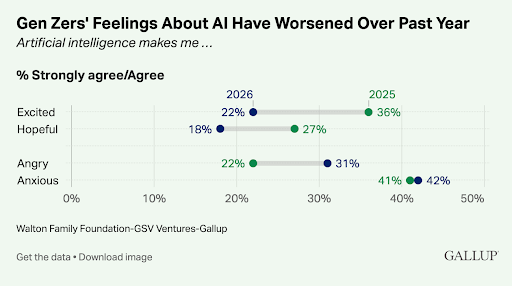
Gallup recently surveyed Gen Zers, ages 14 to 29, and found that in just one year, excitement about AI dropped from 36% to 22%. Anger about AI nearly doubled to almost a third of respondents. And almost half of Gen Z workers now think the risks of workplace AI outweigh any benefits.
What worries them most is what automation is doing to learning. Eight in ten Gen Zers believe that outsourcing tasks to AI will undermine their ability to develop real skills.
That isn’t technophobia. That's a generation with a clear-eyed sense of trade-offs. They're using AI and still asking whether it's good for them. That's exactly the kind of thinking we need more of.
Are their fears legitimate?
Yes. Here's what I think AI leaders should be willing to say out loud.
The disruption to entry-level work is real. There are categories of work AI will absorb, and the transition won't be smooth. Anyone who tells you otherwise is probably trying to sell you something.
Their concerns about the environment are legitimate. The energy demands of large-scale AI infrastructure are significant and growing. The industry can't wave this away with carbon-offset language and good intentions. It requires real commitments, real standards and real accountability.
Their concerns about accountability are real too. Think about what it looks like when AI gets it wrong: A loan wrongly denied. A medical flag missed. A hiring algorithm that screens out qualified candidates. In every one of those cases, someone has to answer for what happened. That someone can't be a model. It has to be a person, and behind that person, a company with its name on the outcome.
What’s AI doing right?
I've spent years building AI inside the insurance industry, one of the most regulated and highest-stakes industries there is. The version of AI I believe in doesn't just replace people. It gives people their time back.
Think about what that actually looks like: A junior analyst spending three hours formatting data instead of finding the pattern in it. A customer support rep answering the same five questions for the 400th time instead of finding new business. A paralegal redlining a contract a model could mark up in seconds instead of focusing on the clause that actually matters.
When AI succeeds at this, something important happens. The people doing that work can finally do more meaningful work.
That's the version of the future I believe in. Not AI simply replacing people, but AI taking the tasks that were never worthy of people in the first place and freeing them for work that actually requires them.
The graduates in those chairs deserve careers where their judgment, empathy, and humanity are what's required. That future is possible. But it doesn't arrive automatically, and it doesn't arrive at all if we build AI without accountability.
What can graduates do next?
The graduates who booed those speakers aren't the problem. They're the ones paying attention. They're applying the critical thinking they spent years developing, and they’re right not to take assurances at face value from an industry that hasn't yet earned that trust.
What I'd ask of them is to stay engaged. Don’t accept the hype, and don’t accept the doom. Hold the people building these systems accountable for the hard questions, and when they enter the workforce they should try to build things better wherever they can.
The class of 2026 is the most AI-literate generation to ever enter the workforce. They understand, better than anyone at those podiums, that the future of AI isn't fixed. It's still being written. We need them all at the table to make a difference.